AI Search Optimization for Business Websites: What Your Agency Should Be Doing in 2026

AI search optimization (also called GEO or AEO) is the practice of structuring a business website so that AI-powered platforms like Google AI Overviews, ChatGPT, Perplexity, and Gemini can understand, trust, and cite it when generating answers. With 37% of consumers now starting searches with AI tools and Google AI Overviews appearing in 88% of informational queries, AI search optimization is essential for any business that depends on being found online.
Traditional SEO focused on ranking in a list of blue links. AI search optimization targets a fundamentally different outcome: being selected as the source that AI engines reference and cite when synthesising answers. Research shows that content with clear structural formatting is 28–40% more likely to be cited by AI engines. Adding verifiable statistics increases AI visibility by up to 22%. Sites with comprehensive schema markup are cited 2–3x more frequently than equivalent sites without it.
This article explains what AI search optimization requires for business websites in 2026: building entity authority so AI systems recognize your brand, implementing comprehensive JSON-LD schema markup, structuring content with question-based headings and self-contained answer blocks for LLM extraction, creating bottom-of-funnel comparison content that AI engines use when making recommendations, and monitoring your brand’s citation frequency across AI search platforms.
The businesses investing in AI search optimization now are building a compounding advantage. Brand search volume is the strongest predictor of LLM citations, showing a 0.334 correlation that outweighs traditional backlinks. 76.4% of ChatGPT’s most-cited pages were updated within 30 days. These are the signals that determine AI visibility.
What Is AI Search Optimization?
AI search optimization (also called GEO or AEO) is the practice of structuring your website and content so AI-powered search tools can understand, trust, and cite your business when answering relevant queries. Unlike traditional SEO that targets ranking positions, AI search optimization targets being selected as the source AI engines reference when generating answers.
This distinction matters because AI search tools do not simply link to websites. They synthesise information from multiple sources and present a generated answer. Being cited in that answer is the new equivalent of ranking on page one.
Why Does AI Search Matter for Businesses Right Now?
AI search matters because adoption is accelerating rapidly. 37% of consumers now start searches with AI tools. Google AI Overviews appear in 88% of informational queries. ChatGPT processes over a billion queries daily. Perplexity is growing fast among professionals who influence purchasing decisions. If your business depends on being found online, AI search is a present reality, not a future concern.
Visitors from AI search are 4.4x more valuable than traditional organic visitors. The businesses adapting now are capturing visibility and customers that their competitors are losing.
How Should Your Agency Build Entity Authority?
Your agency should build entity authority by establishing your business as a clearly defined, recognized concept in the eyes of AI systems. This means consistent business naming across all platforms, structured information about services and location, comprehensive Organization and LocalBusiness schema, and content that establishes topical expertise in your industry.
Research shows that brand search volume is the strongest predictor of LLM citations, with a 0.334 correlation that outweighs traditional backlinks. Entity authority is built through consistency across your website, Google Business Profile, LinkedIn, and industry databases.
For a deeper understanding of how to choose an agency with these capabilities, see How to Choose a Web Design Agency That Actually Delivers SEO and AI Search Results.
Why Is Schema Markup Critical for AI Search?
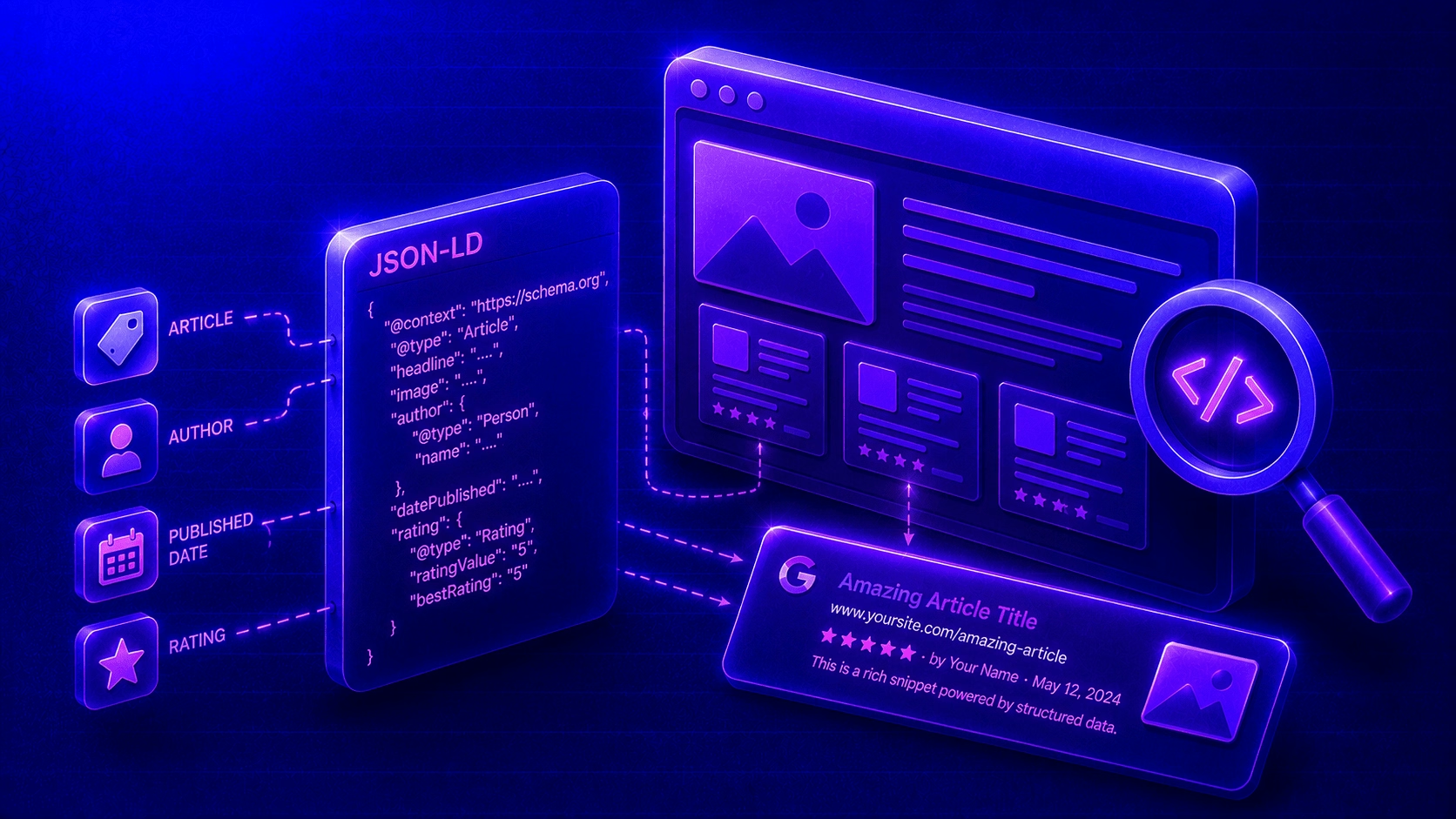
Schema markup is critical because it provides AI systems with a machine-readable translation layer that removes ambiguity about what your content represents. JSON-LD structured data tells AI engines exactly what your business does, who created the content, and what authority it carries. Sites with comprehensive schema are cited 2–3x more frequently by AI engines.
Your agency should implement Organization, LocalBusiness, Article, FAQ, and BreadcrumbList schema across your site as standard practice. For a full guide on what to implement and why, read Schema Markup and Structured Data: The Hidden Advantage Most Web Designers Ignore.
How Should Content Be Structured for AI Extraction?
Content should be structured using BLUF (Bottom Line Up Front) formatting with 40–60 word answer blocks at the start of each section, question-based H2/H3 headers, short focused paragraphs under 120 words, FAQ sections with self-contained answers, and comparison tables where relevant. This makes content easily extractable by LLMs that parse pages into semantic segments.
Research shows that content with clear structural formatting is 28–40% more likely to be cited by AI search engines. Pages using 120–180 words between headings receive 70% more ChatGPT citations than sparse sections.
What Is Bottom-of-Funnel Content and Why Does AI Love It?
Bottom-of-funnel (BOFU) content meets customers at the decision-making stage with comparison pages, service breakdowns, and detailed product information. AI engines favour BOFU content because it provides the structured, factual information they need to make recommendations. Listicle-style comparison articles are particularly effective for AI search visibility.
Your agency should be creating content that answers the specific questions buyers ask before making a purchase decision. This directly supports both AI citation and conversion.
How Do You Monitor AI Search Visibility?
Monitor AI search visibility by tracking AI citation share across platforms like ChatGPT, Perplexity, and Google AI Overviews, measuring referral traffic from AI tools (chatgpt.com, perplexity.ai), checking sentiment accuracy in AI-generated brand descriptions, and using tools like Semrush’s AI Toolkit to measure AI Overview appearances and citation frequency.
You cannot improve what you do not measure. 76.4% of ChatGPT’s most-cited pages were updated within 30 days, so freshness monitoring is also essential.
To understand the investment required, see How Much Should You Pay a Web Design Agency? Pricing, ROI, and What to Expect.
At Proxy, AI search optimization is built into our web design process from day one. It is part of how we build websites that deliver results in 2026 and beyond.
Frequently Asked Questions
What is GEO in digital marketing?
GEO stands for Generative Engine Optimization. It is the practice of optimizing your website and content to be cited in AI-generated search answers from platforms like ChatGPT, Google AI Overviews, and Perplexity. GEO focuses on entity authority, schema markup, structured content, and brand visibility across AI systems.
Is AI search replacing Google?
AI search is not replacing Google but is fundamentally changing how Google works. Google AI Overviews now appear in 88% of informational queries. AI tools like ChatGPT and Perplexity are capturing a growing share of search queries. Businesses need to optimize for both traditional and AI search.
How do I get my website cited by ChatGPT?
To get cited by ChatGPT, ensure your website has comprehensive schema markup, well-structured content with clear answer blocks, authoritative information backed by data, a strong entity presence across platforms, and content updated within the last 30 days. Brand authority and content structure are the strongest citation signals.
What is the difference between SEO and GEO?
SEO targets ranking positions in traditional search results (blue links). GEO targets being cited as a source in AI-generated answers. SEO focuses on keywords and backlinks. GEO focuses on entity authority, schema markup, content structure, and brand visibility. Both are essential in 2026.
Does my web design agency need to understand AI search?
Yes. In 2026, any web design agency that does not understand and actively implement AI search optimization is building websites that are already dated before they launch. Schema markup, entity optimization, and content structure for LLM parsing should be standard deliverables.
How quickly can I see results from AI search optimization?
Most businesses see measurable changes in AI citation rates within 4–8 weeks of implementing a comprehensive AI search optimization strategy. However, building sustained entity authority is a longer-term effort that compounds over time.